
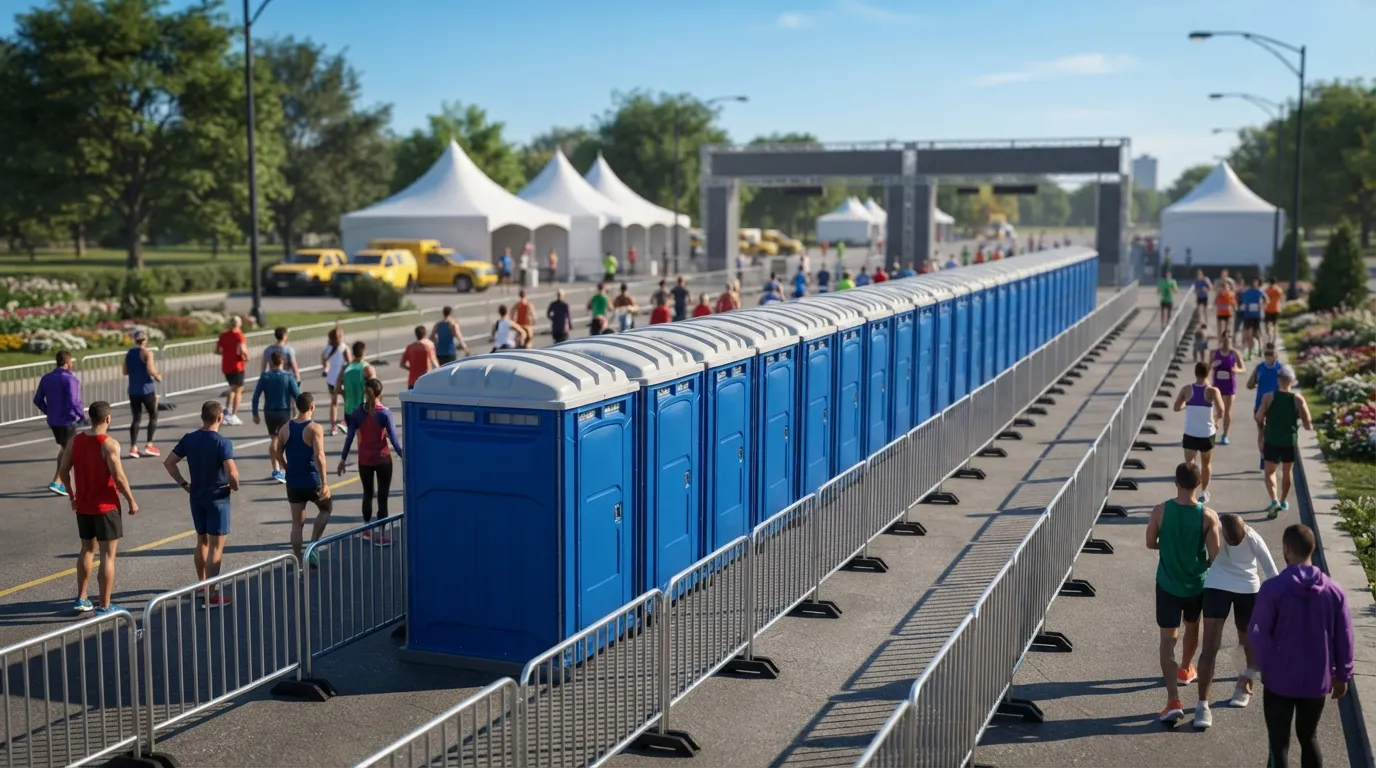
How many restrooms does a marathon or race need?
OSHA 1926.51(c) sets a baseline of 1 toilet for every 20 workers on a job site, and race organizers use that same math as a starting point for participants, then add units at high-traffic points like the start corral and finish line. A 5K with 300 runners behaves differently than a half marathon with 2,000, so our guide on how many porta potties you need walks through the runner-count math in more detail. For most races we stage standard units at a ratio built from that 1-per-20 baseline, then double up near the finish where lines form fast right after runners cross. Spectator zones need their own count too, separate from the runner tally. If the race draws a crowd that lingers, like a post-race festival area, treat that as its own cluster and staff it like an event restroom setup rather than folding it into the runner count. Races in Perris that route near Good Hope, about 4.9 miles southwest, or Romoland, 5.7 miles southeast, sometimes split restroom clusters across two towns along the course, and that changes how many trucks we send and when. We also recommend at least one ADA accessible unit per cluster, per ADA Standards 213.2, which calls for 5 percent of clustered single-user units to be accessible with never fewer than one. A 60 inch turning circle, per ADA Standards 304.3.1, needs to fit around each accessible unit's pad.
Where should restrooms go along a race course?
Restrooms belong at the start, the finish, and every aid station past mile 3 or so, spaced so no runner walks far off-route to reach one. Placement guidance matters more for races than for static job sites because the units have to sit near a road or trail the delivery truck can actually reach. A standard unit runs about 44 by 48 inches on the ground and stands roughly 92 inches tall, small enough to tuck beside a water table without blocking the course. Ground needs to be reasonably level and firm, per the same stability principle ADA Standards 302.1 requires for accessible routes, since a unit on soft dirt tips or sinks. If your race finish sits near a venue that also needs power, for lighting, timing clocks, or a sound system, a temporary power pole or a light tower often gets staged alongside the restroom cluster. Knowing how to brace a temporary power pole matters here too: when we brace one at a race finish, we set it on a stable base away from foot traffic and cable-cover any run that crosses a walkway, the same housekeeping logic behind OSHA 1926.25's rule on keeping work areas clear of hazards. Courses that pass through Mead Valley, about 7.9 miles northwest of Perris, or stretch toward Lake Elsinore, 11.5 miles southwest, sometimes need a second delivery run split across those legs, and we plan that into the route the week before race day. Emergency porta potty rental is worth having on standby too, in case a unit gets knocked or a crowd surges past the plan.
What does a marathon restroom rental cost?
A standard unit rents for an event day in the range below, and most races book by the single event rather than a weekly term.
| unit | duration | typical price |
|---|---|---|
| standard | event | $400 |
| ada | day | $230 |
| deluxe | day | $300 |
| trailer | event | $3,500 |
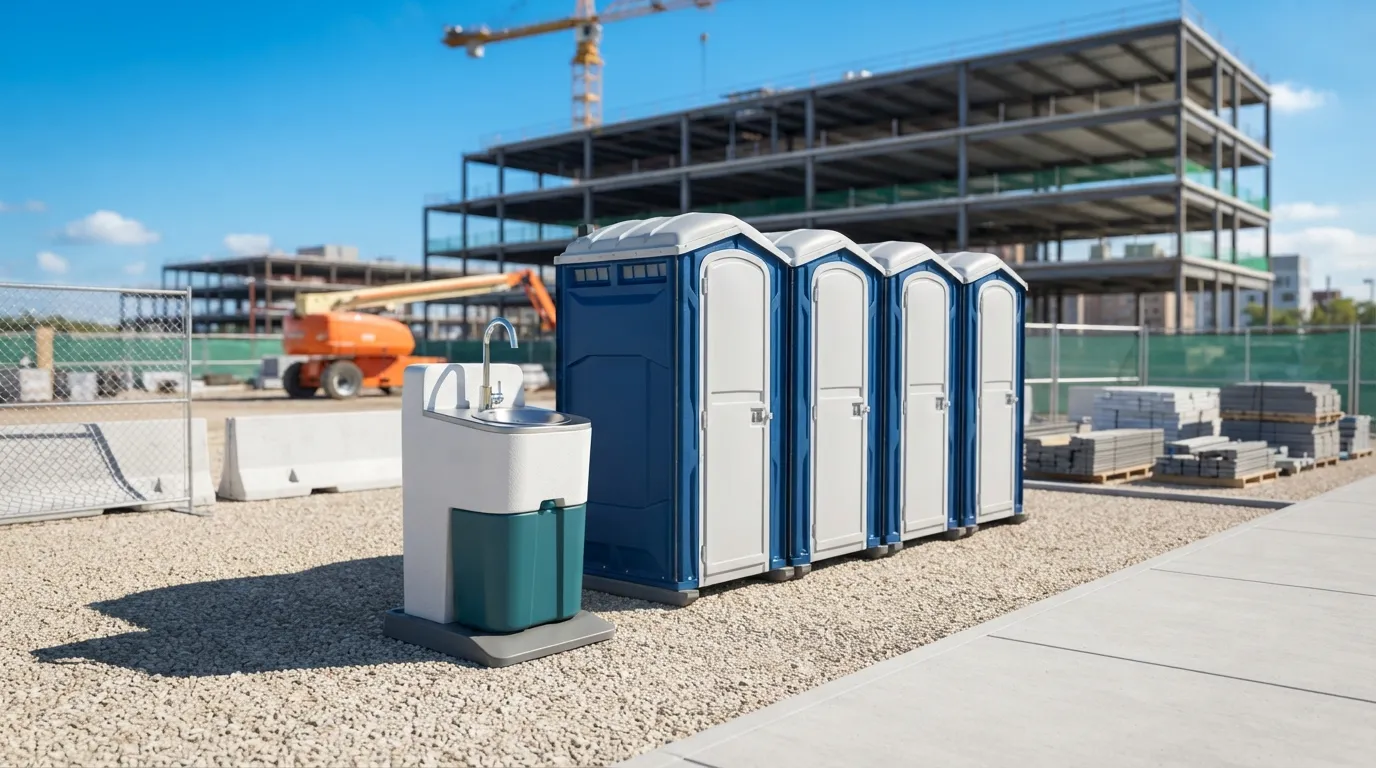
Larger races that want a nicer finish-line experience sometimes add a restroom trailer instead of, or alongside, standard units, especially an 8 stall restroom trailer for a big finish area. See restroom trailer rental cost for how that pricing breaks down further. A delivery fee applies on top of the unit rate, and porta potty rental cost covers how that gets figured for a one-day event versus a longer booking. Handwashing matters too: 29 CFR 1910.141(d)(2) requires soap and towels or a hand-drying device at washing stations, and hand sanitizer alone does not satisfy it, so we pair handwashing station rental with restroom clusters at aid stations where runners grab food.
How far in advance should we book race restrooms?
Book as soon as your course map and runner count are set, ideally 4 to 6 weeks out for a race over 500 runners. Popular fall race weekends fill delivery slots fast. Request a quote early and we will hold placement based on your route.
Do we need accessible units at a race?
Yes. ADA Standards 213.2 requires at least 5 percent of clustered units to be accessible, never fewer than one per cluster. Place them on firm, level ground per ADA Standards 302.1, with a 36 inch clear route per ADA Standards 403.5.1.
Can restrooms be moved mid-race if the course changes?
Not easily once trucks are staged, so lock the route before delivery. If a last-minute change is unavoidable, call ahead. Our emergency septic service and standby crews can sometimes reposition a unit between waves.
What about restrooms for spectators, not just runners?
Spectator zones need a separate count from runner units. A finish-line festival area with vendors and families behaves like a festival restroom setup, not a race-course cluster.
Do we need a permit to place restrooms on city streets?
Placement in the public right of way needs confirming with the City of Perris directly; check our porta potty permit requirements page and contact the city before finalizing your course layout.
Next step
Get a delivery date
Tell us the address, the dates and the headcount. We size the order and confirm the route.